The widespread use of artificial intelligence in content creation is not changing what good communication looks like. It is making the gap between strong, purposeful content and low-quality output more visible.
For many, artificial intelligence (AI) is now a routine part of how digital content is created, for example, it can be used for image enhancement, drafting copy and editing video. The world is now in a phase where fully synthetic content is commonly produced and shared online at an increasing level. As these tools become more capable and more widely used, social media platforms have responded by introducing labelling systems. AI labels mean audiences are no longer just judging what is said but how it is produced and why.
The intention is not to ban AI‑generated content, but to provide audiences with clearer context about what they are seeing as they scroll. For businesses and organisations, this changes how content performance and quality should be assessed.
AI labelling is ultimately about transparency. As AI‑generated content becomes more realistic, it is becoming increasingly difficult for users to distinguish between human‑created, AI‑assisted and fully synthetic material. Labelling is designed to address that gap in uncertainty and support informed engagement, particularly in environments where credibility and trust are key.
These labelling systems are not designed to judge whether content is good or bad, helpful or harmful. They provide origin and context, not editorial judgement. This distinction matters for business and organisations who might be concerned they could be penalised for moderate AI assistance. Platforms currently focus on and prioritise preventing deception rather than discouraging productivity or innovation.
A more significant implication of AI labelling is not compliance, but content standards. Regardless of how content is produced, organisations remain accountable for accuracy, quality and intent. Used well, AI can support creativity, improve accessibility and increase efficiency. Used poorly, it produces high‑volume, low‑effort output that lacks originality and insight. Consistently poor content creates content fatigue or “slop” which weakens credibility, trust and has an increasing reputational risk over time.
Once content is labelled as AI‑generated or AI‑assisted, audiences view it differently and expectations shift. They look more closely at quality, originality, and usefulness. Repetitive visuals, generic messaging or shallow analysis become more visible, not less. Labelling does not create poor content, but it makes poor content easier to identify. For organisations, the reputational risk is not being seen to use AI. It is being seen to depend on it without adequate editorial judgement, originality, or purpose.
Recent backlash to Coca‑Cola’s AI‑generated Christmas advert shows how quickly audiences interpret AI use as a signal of quality and intent. When AI is perceived to replace craft rather than support it, transparency does not build trust, it highlights the gap.

Most major platforms are taking a disclosure‑first approach, supported by technical standards and creator responsibility to formalise the expectations around content generation and distribution.
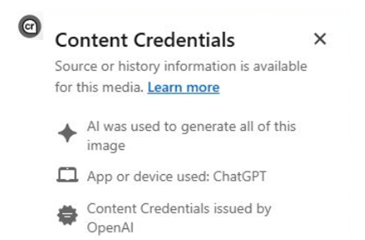
LinkedIn has introduced Content Credentials, using the C2PA industry standard. Where this information is present, users can see whether AI was involved in creating an image or video, which tools were used, and where the content originated.
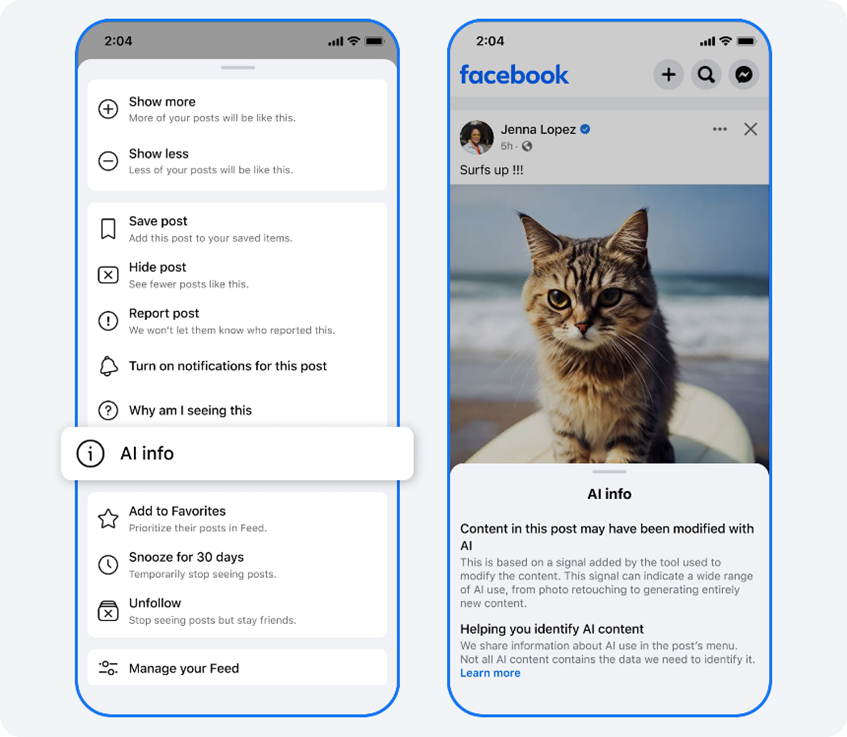
Meta applies an “AI Info” label across Facebook, Instagram, and Threads to content that is fully AI‑generated or significantly altered. Labels may be applied automatically via metadata or watermarks, or manually where creators disclose AI use. The aim is to provide context rather than restrict distribution.
Instagram places additional responsibility on creators. Realistic AI‑generated video or audio must be labelled at the point of posting, while images may also receive labels if AI use is detected. Failure to disclose where required can result in penalties such as reduced reach or content removal, reinforcing transparency as an expectation rather than an option.

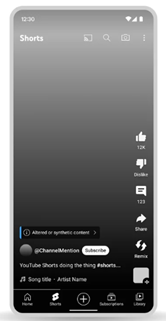
YouTube has adopted a similar approach, requiring creators to declare altered or synthetic content, with more prominent disclosures applied to sensitive topics such as elections or public policy.
Across the different platforms, the patterns are consistent. Disclosure comes first with action taken only if there is a risk of misleading people. That said, it is important to recognise the limits of AI labelling and be aware of what it can and cannot do:
AI‑generated content and AI labelling are now structural features of the social media landscape. Transparency is becoming standard practice. Organisations that perform well will be those that:
In an already crowded and noisy social media landscape, attention is hard to earn, and so now quality matters more than ever. Used carefully, AI strengthens communication. Used lazily, it generates noise that audiences quickly learn to ignore. The introduction of labels is simply making that distinction easier to see. Success depends less on whether AI is used and more on how carefully it is governed.
What poor AI‑assisted content tends to look like
What good AI‑assisted content looks like
What audiences see
AI has supported the process, but human judgement defines the outcome.